
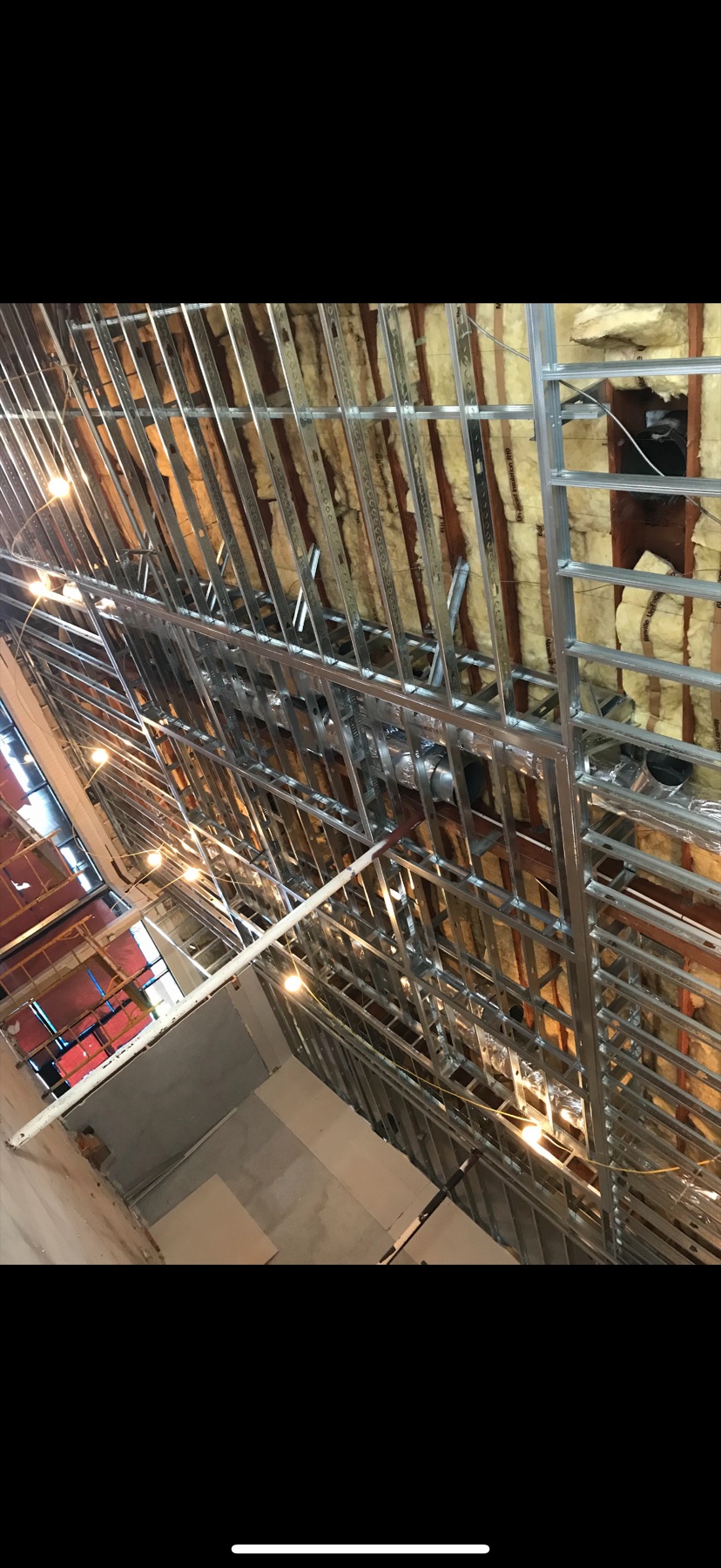
If you're framing a new interior wall in San Diego, the choice between light-gauge metal studs and wood studs isn't always obvious. Steel won the commercial argument decades ago. For residential, the answer depends on the job. Here's how we actually pick on real projects.
Quick history: how steel took over commercial
Until the 1970s, almost all interior partition framing was wood. Lumber was cheap, the workforce knew it, and there was no compelling reason to switch. Then a few things lined up:
- Lumber prices started climbing and got volatile
- Fire codes tightened, and steel doesn't burn
- Light-gauge cold-formed steel manufacturing got dialed in
- Insurance underwriters started preferring steel framing in commercial occupancies
By the 1990s, light-gauge steel was the default for commercial interior partitions, and it's only grown since. Most new commercial buildouts in San Diego — offices, retail, medical, restaurant — are 100% steel-framed interior walls.
Residential mostly stayed wood. That's changing slowly in some custom homes and multi-family work, but for a typical remodel or addition, wood remains the dominant choice. Both are valid. They just optimize for different things.
Cost: closer than people think
The conventional wisdom is "wood is cheaper." That used to be reliably true. It isn't anymore.
Light-gauge steel (typical 20-25 gauge) studs and tracks are priced more stably than lumber. When lumber spikes — and it has spiked dramatically several times since 2020 — steel is often equal or cheaper on raw material. The labor cost difference is smaller than people assume: a trained crew can frame steel about as fast as wood, sometimes faster.
On a typical commercial buildout, steel framing is competitive or cheaper than wood, full stop. On residential, wood usually edges out by 10-20% on material, with labor roughly equal. Not the 2x difference some people imagine.
Where steel clearly wins
1. Straightness and consistency
A wood 2x4 is grown, milled, and stacked outside until it gets to your jobsite. Some of them are straight; some of them are bowed; some twist as they dry out post-installation. Crews spend real time culling and crowning wood studs.
A 20-gauge steel stud is manufactured to spec. Every one is straight, every one is identical, no bowing, no twisting, no shrinkage. For long walls, tall walls, or any wall that has to be plumb a year from now, steel is dramatically better.
2. Fire ratings
Steel doesn't burn. UL-listed fire-rated assemblies are easier to achieve with steel and are pre-engineered in standard configurations. For 1-hour and 2-hour rated walls — required in most commercial corridors, shaft walls, demising walls in multi-family — steel is the practical default.
You can frame fire-rated assemblies in wood, but you'll need to use specific lumber grades, install gypsum carefully, and document it well. Steel makes the inspection easier.
3. Termites and moisture
San Diego County has termites. Steel doesn't care. Wood does.
In bathrooms, laundry rooms, slab-on-grade construction in older homes, or anywhere subgrade moisture might be in play, steel removes a whole category of long-term failure modes. Pressure-treated wood is the alternative but adds cost and a specific smell most people don't want in their living space.
4. Acoustic performance
Steel studs flex slightly, which is actually good for acoustics — they don't transmit sound vibration the way rigid wood studs do. For a sound-rated wall (think a home theater, a bedroom adjacent to a noisy room, or a demising wall in multi-family), steel framing combined with mineral wool batt and Type X drywall gets you to a higher STC rating than wood.
5. Layout flexibility and waste
Steel studs come in standard lengths but cut cleanly with a chop saw or aviation snips — no splintering, no waste from cull. The track-and-stud system lets you adjust layout fast. For complex commercial layouts with lots of corners, soffits, and bulkheads, steel is just easier to work with.
Where wood still wins
1. Hanging stuff on walls
This is the big one for residential. Hanging a 60-inch TV, a kitchen cabinet, a heavy bathroom mirror, or a curtain rod into a wood stud is straightforward — drive a screw, you're done. Into a steel stud, you need toggle anchors, specific stud-thread screws, or in-wall blocking installed during framing.
For commercial work, this is fine — blocking gets engineered into the framing plan. For residential, where a homeowner is going to hang random stuff over the next 20 years, wood is more forgiving.
2. Load-bearing in light residential
Interior load-bearing walls — the ones holding up roof joists or upper-story floor systems in a typical residential home — are usually wood. You can do load-bearing in heavier-gauge cold-formed steel, but it requires a structural engineer's design and the heavier sections aren't priced for casual residential use.
If your residential remodel includes a load-bearing interior partition, wood is the practical choice.
3. Tying into existing wood framing
In a residential remodel where the existing house is wood-framed, adding a steel wall creates a transition condition — different fasteners, different attachment methods, different acoustic behavior. Sometimes that's fine. Often it's just extra complication for no clear gain.
4. Sound transmission via electrical and plumbing
The acoustic advantage of steel is real, but it depends on careful detailing — proper electrical box backing, no "telegraphing" between studs. In a sloppily-detailed steel wall, sound can transmit worse than wood. The crew matters as much as the material.
The decision framework we actually use
On a real project, here's roughly how we sort it:
- Commercial buildout (TI, retail, medical, restaurant, office): Steel, every time. Faster, straighter, fire-rated easier, and what the spec calls for.
- Multi-family demising walls: Steel. Fire and acoustic ratings come almost free with steel; with wood you fight for them.
- Single-family new construction: Wood for load-bearing and most exterior; mixed for non-bearing interior. We'll often steel-frame wet areas (bathrooms, laundry) and wood-frame everything else.
- Residential remodels in an existing wood-framed home: Wood, unless there's a specific reason (acoustic, fire, moisture, slab-on-grade contact) to switch.
- ADUs and custom homes: Either, depending on the architect's spec and the homeowner's priorities. Steel is gaining ground in newer ADU plans.
- Tall walls (over 12 ft) or long unbroken walls: Steel. Wood will eventually move; steel won't.
The right answer almost always depends on what's on the other side of the wall, what's going to hang on it, and what code requires. Anyone telling you steel is always better or wood is always better isn't framing real projects.
What this means for your project
If you're a GC running a buildout, you already know the answer — steel. The conversation worth having is gauge, layout sequencing, and how we'll integrate with your MEP rough-in.
If you're a homeowner doing a remodel, the answer is usually wood with some specific exceptions for wet areas, sound-sensitive zones, or tall plumb walls. Don't let anyone upcharge you for steel on a typical bedroom addition; don't let anyone talk you out of steel on a media room or a basement that gets damp.
Either way, if you want a real opinion on your specific project, that's exactly the kind of question we'll work through on a free estimate. We frame both — wood crews and steel crews — and we'll spec what your project actually needs, not what we feel like installing this week.